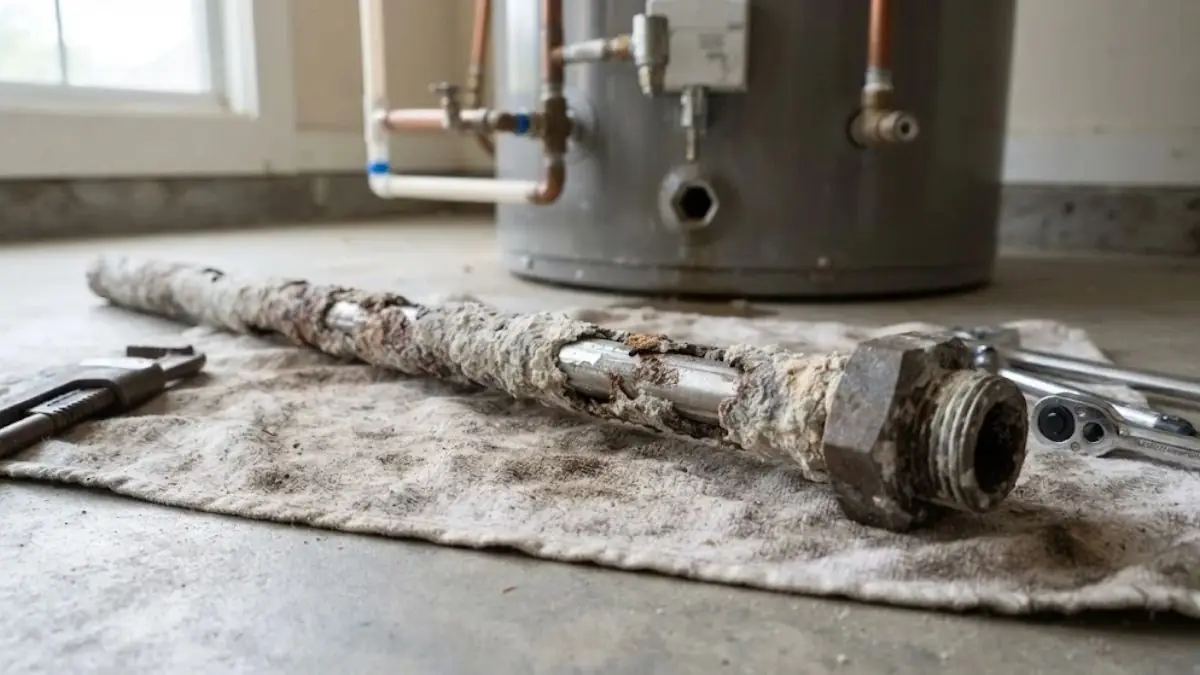
A water heater anode rod is a metal rod, usually magnesium or aluminum, that hangs inside the tank and corrodes on purpose so the steel tank does not. Most tanks should have the rod inspected every few years and replaced when it is worn down to a thin core wire or coated heavily. A fresh rod is a small cost next to a new tank.
If your water heater is already leaking from the tank body, a new rod will not help. That is a replacement situation, and our water heater replacement page explains what to do.
What the anode rod does
Hot water attacks steel. Inside a glass-lined tank, tiny gaps in the lining expose bare steel, and the rod gives the water something easier to corrode. As long as the rod has metal left, the tank steel is protected. When the rod is gone, the tank starts to rust from the inside, and the typical outcome is a leak from the bottom or a seam.
That is why the rod is called a sacrificial anode. It is designed to be used up. The only question is whether you replace it before the tank pays the price.
How to tell if the rod needs replacing
Age of the tank
If the tank is more than three or four years old and the rod has never been checked, it is worth a look.
Rotten-egg smell
Sulfur smell in hot water only can point to a reaction at the rod. A different rod type sometimes helps.
Rusty or discolored hot water
If only the hot side runs brown, the tank liner may be failing and the rod may already be gone.
Popping or rumbling
Sediment is the usual cause, and a flush and rod check go together.
Rod looks thin
A rod worn to the steel core wire has little protection left.
Checking and replacing the rod
The rod screws into the top of the tank, either under a hex head on the top or built into the hot outlet. Pulling it takes a long breaker bar and room above the tank, since many rods are about 40 inches long. Many people use a flexible segmented rod in tight spaces.
Shut off power or gas
Turn off the breaker or set the gas control to off, and close the cold water inlet.
Relieve pressure and drain a little
Open a hot tap and drain a few gallons so the water level is below the rod.
Loosen the rod
Use a socket and a long handle. A stuck rod may need an impact tool.
Inspect and replace
A rod coated in scale or worn to a wire is spent. Install a new one with thread sealant if the maker calls for it.
If the rod will not budge, or the tank is old and corroded, stop. A stuck fitting on a weak tank can turn a small job into a leak. A plumber can judge whether the tank is worth saving.
Magnesium, aluminum or powered rods
| Type | Strengths | Watch for |
|---|---|---|
| Magnesium | Protects well and is the common factory choice | Can cause a sulfur smell in some water |
| Aluminum or aluminum-zinc | Lasts longer in some conditions | Aluminum residue is a concern for some households |
| Powered | Uses a small current and does not wear out like a sacrificial rod | Needs power and costs more |
Choose by water and by tank warranty. Some manufacturers want a specific rod type, and swapping can change the warranty terms, so check the label before you buy.
Local note: Union County water and your tank
What Union County Water reports for Indian Trail
Union County Water's 2023 water quality report listed average hardness of 23 ppm, which is very soft, and an average pH of 7.11. The report lists chloramine as the final disinfectant. Soft water does not build thick scale on an anode rod the way hard water does, so rod condition here depends more on tank age and temperature than on scale.
Soft, near-neutral water is not an invitation to skip checking. Rods in soft water can still be used up. A small part of Indian Trail is served by another utility, so ask your utility for its report if you are unsure.
For a home in the nearby county seat, the City of Monroe's FY2023 report describes chloramine and a pH of 7.5, which is also a mild range. Our Monroe plumber page explains the details, and the service areas page shows where we work.
When a new rod is not worth it
If the tank is more than ten years old, rusts at the base or has leaked, a new rod does not save it. At that point money is better spent on a new unit. Our water heater repair page lists which faults are worth fixing and which are not.
What the rod costs compared with the tank
An anode rod is among the least expensive parts you can buy for a water heater, and replacing one every few years is routine maintenance for plumbers. A tank that dies early because nobody looked at the rod costs far more, plus the water damage that often comes with it. The comparison is lopsided, which is why we raise the rod whenever we are already working on a heater.
The catch is access. Some tanks have the rod under a plastic cap on top with a hex head. Others have it combined with the hot outlet nipple. A few sit so close to the ceiling that a straight rod will not clear. Flexible rods bend in the tank and solve that, though they cost a little more. Tell the plumber what clearance you have above the unit when you call.
Mistakes that turn a rod swap into a tank replacement
Forcing a seized rod
A rod that has been in for a decade can be locked in. Heavy force can crack the fitting or tear the glass lining near the threads.
Skipping the shutoff
Working with the cold inlet open and the heat on risks a scald and a burned-out element if the tank drains.
Wrong rod for the warranty
Some makers state a rod type. Swapping to something else can change the warranty terms.
Reusing a thin rod
A rod worn to the core wire is nearly gone. Putting it back protects nothing.
Ignoring the sulfur smell
Rotten-egg odor in hot water can mean a reaction at the rod, and a different rod material may fix it.
If you are not sure the tank is sound, have it looked at before you spend anything. A rusty base, a damp pan or crusted fittings are signs that a rod will not rescue the tank. Our water heater installation page explains what a planned replacement involves when you decide to move on.
Sources behind this guide
Rod types and warranty terms come from the water heater manufacturer's manual. Union County Building Code Enforcement and Union County Water are the sources for the permit and water facts, and relief valve and discharge rules follow the State Plumbing Code, which adopts the International Plumbing Code (IPC).
Anode rod questions
How often should I check my water heater anode rod?
Many plumbers suggest checking every three to five years and sooner in a tank that is not performing. The rod's condition tells you more than the calendar.
Does soft water in Indian Trail mean I can skip the rod?
No. Union County Water reported very soft water, and the rod still wears. Soft water simply means scale is less of an issue than in hard-water towns.
Can I replace a rod myself?
A confident homeowner can, but tight space, a stuck fitting and the weight of a full tank make it a job for a plumber in many homes.
Will a new rod fix a rusty hot water problem?
Not if the tank liner has already failed. A new rod protects what is left. It does not repair damage already done.
Does Union County require a permit to swap an anode rod?
A rod swap is maintenance inside the existing tank, not a change in fuel, location or capacity. Confirm with Union County Building Code Enforcement if you are unsure.