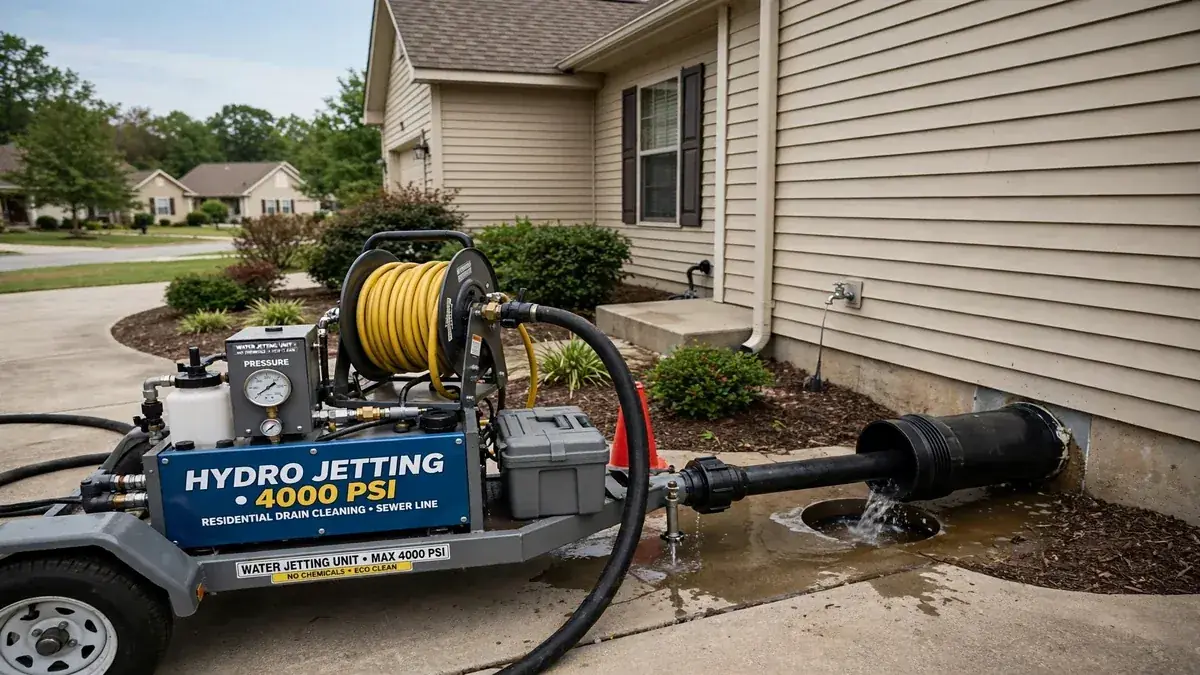
If a drain keeps clogging every few months, a snake has probably been punching a hole through the blockage and leaving the pipe wall coated. Hydro jetting uses high-pressure water from a nozzle to scour that wall clean. The line is answered 24/7, and when a main line is backing up tonight, we can tell you whether jetting or a cable is the right first step.
If water is already coming up in a tub or floor drain, stop using every fixture in the house until a plumber confirms the line is clear. More water only adds to the backup.
What hydro jetting does that a cable cannot
A cable cuts a channel through a clog. Water pressure from a jetter removes the material itself, from the full circumference of the pipe. Grease that has hardened into a ring, fine silt, scale and the fibrous mass of small roots all respond to a properly sized nozzle at the right pressure.
The result is a pipe that flows like a pipe again, not a narrow tunnel. For restaurants, multi-unit buildings and any home with a repeat clog, that difference shows in the months after the visit.
When jetting is the wrong tool
Jetting is not magic. A pipe that has collapsed, offset or cracked can be damaged by high pressure, and we do not jet blind. A camera look comes first on any line with a history of problems, so we know what we are working with. If the camera shows a broken section, we talk about sewer line repair instead of cleaning.
Grease buildup
Common in kitchen lines and commercial grease-heavy drains. Jetting strips it back to bare pipe.
Fine root intrusion
Hair-thin roots entering joints can be cut and flushed out. Heavy roots may need cutting first.
Scale and silt
Slow-growing deposits that narrow the pipe over years. Jetting restores the bore.
Repeat main line clogs
If a cable only helps for a few weeks, the pipe wall is the problem, not the blockage.
Sewer backup emergency: how a jetting visit runs
Assess and camera
We ask about the history, open a cleanout and look at the line when the situation calls for it.
Set up and clear
A jetter hose with the right nozzle is fed into the line and worked through the problem area in passes.
Flush and check
We flush debris out of the line, then run water to confirm full flow at every fixture.
Report back
You hear what was found, what it means and whether repeat service or a repair is advisable.
Local conditions that make jetting worth considering
Most Indian Trail homes were built after 1990, and their lateral lines are PVC. PVC is smooth and tolerates a correctly set jetter well. The trouble in these neighborhoods is less about corrosion and more about grease, wipes and roots from trees planted along lot lines in the 2000s. Jetting suits those problems.
On older Monroe lines near the historic districts, clay or cast iron may be present. We always assess pipe material before choosing pressure, and we would rather camera first than risk a fragile line.
Cost factors for hydro jetting
Jetting is usually a maintenance and cleaning cost and is not normally covered by homeowners insurance. Sewage backup damage inside the home may be covered if you carry the endorsement.
What jetting does not replace
Jetting cleans pipe. It does not fix a break, a belly or a joint that has pulled apart. A camera look afterward shows the real condition of the pipe once it is clean. If the camera shows damage, the next step is a repair, and cleaning only buys time.
For homes with a history of roots, jetting is often paired with a repair or a lining. For restaurants, it is paired with a schedule. For a one-time grease clog, jetting may be all that is needed. The point is to match the tool to the cause.
Scheduling for businesses
Commercial kitchens and similar businesses often schedule jetting every few months. The right interval depends on grease load, fixture counts and how the lines are laid out. A short log of past clogs helps us set a schedule that prevents emergencies without wasting money.
Standards behind jetting
Jetting is a cleaning method, not a code item, but the pipe it cleans is governed by the State Plumbing Code, which adopts the International Plumbing Code (IPC). Manufacturers publish pressure and nozzle guidance for their jetting equipment, and we work within those limits according to the pipe material and condition shown on camera.
Hydro jetting questions
Do you handle hydro jetting emergencies at night or on weekends in Indian Trail?
Yes, when the camera or the symptoms show the pipe can take it. Our line is open 24/7, and the plumber will tell you if a cable should go first to restore flow.
Is hydro jetting safe for my pipes?
On sound PVC and many cast iron lines, yes. We do not jet a pipe that is cracked, collapsed or offset, and we check before we start.
How often should a line be jetted?
It depends on the cause. Grease-heavy commercial lines may need a schedule. A home line often needs jetting once and then a change in habits.
Is jetting better than snaking?
It cleans the pipe wall, which a cable does not. A cable is faster and cheaper for a simple one-time clog.
Will it remove tree roots for good?
Jetting clears the roots inside the pipe. If a joint is open, roots can return, and a repair or lining may be the lasting answer.
Do you work in Monroe too?
Yes. See the Monroe page for coverage details.