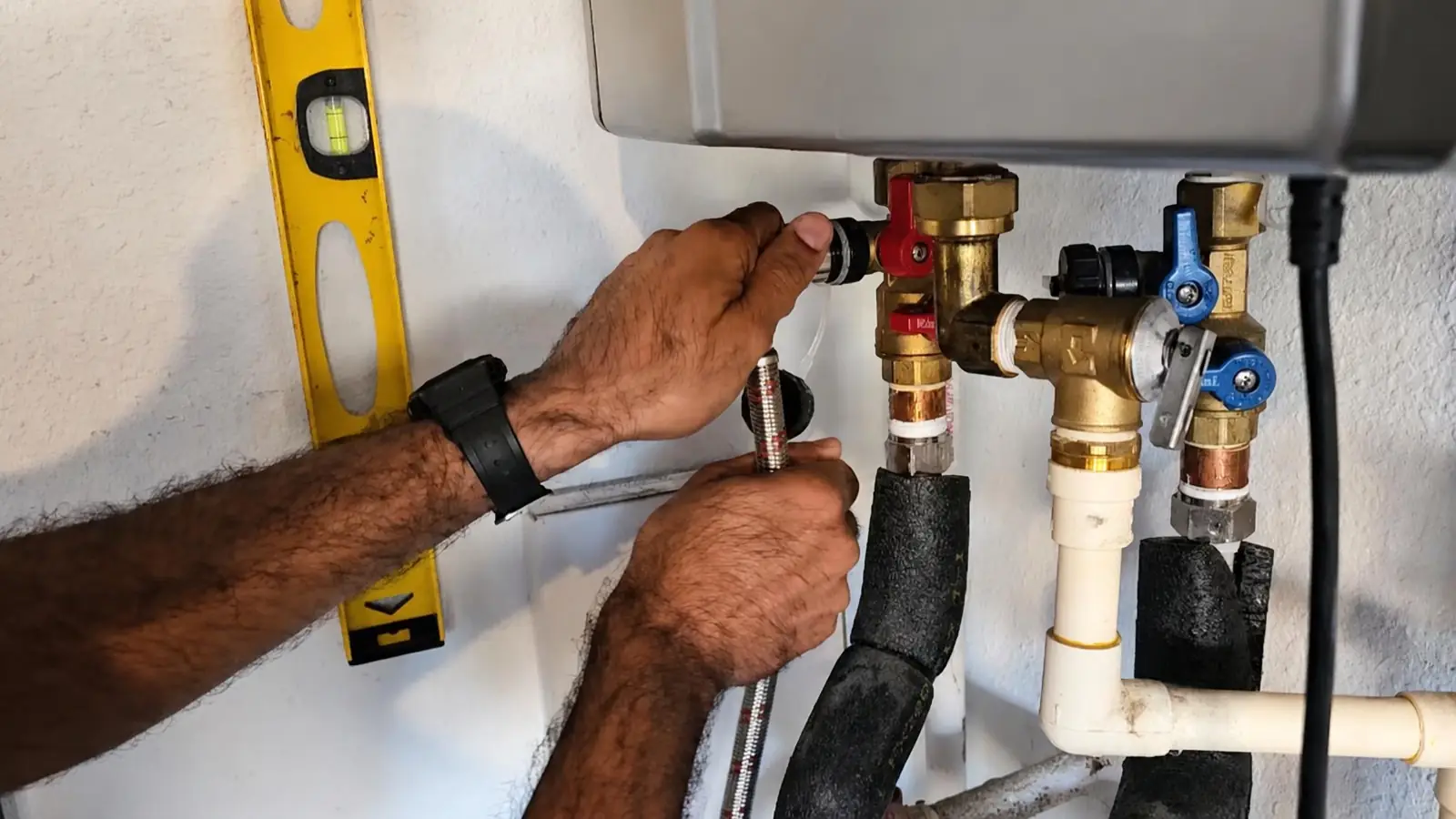
A tankless water heater heats water as it flows instead of storing it, so it never runs out of hot water in the same way a tank does. It also needs a larger gas line or a hefty electrical feed, a specific vent material and a yearly flush. This page covers installing one, flushing and descaling one, and fixing error codes on one in Indian Trail, NC.
Most tankless questions are planning questions, not emergencies. If your unit has stopped and you have no hot water, call anyway, since the line is answered 24/7, and we can talk you through the reset and the flush valve check.
What a tankless installation needs
Gas supply
Gas tankless units draw a lot of fuel at once. The existing line from the meter may need to be larger, and the manufacturer's sizing chart decides.
Venting
Most use sealed stainless or polypropylene vent pipe, routed through a wall or roof. The wrong material or run is a safety problem.
Condensate drain
High-efficiency condensing units produce acidic condensate that needs a safe drain path and often a neutralizer.
Electrical and controls
Gas units need a small circuit for the fan and board. Electric tankless units may need a large new circuit and panel space.
Service valves
Isolation valves let a plumber flush the heat exchanger without cutting into the lines. We install them on every unit.
Flushing and descaling: the part owners forget
A tankless unit needs a periodic flush to clear mineral and sediment from the heat exchanger. In hard water this is critical. Union County Water reports very soft water, with average hardness of 23 ppm in its 2023 report, so scale builds more slowly here, but sediment, debris and the age of your lines still collect. Skipping the flush shortens the life of the exchanger.
A typical flush circulates a descaling solution through the unit with a small pump for a set time, then rinses and checks the inlet filter. We also read the error history on the display and test flow, ignition and exhaust. Our water heater repair page covers tank units if you have both types.
Tank or tankless: a plain comparison
| Factor | Tank | Tankless |
|---|---|---|
| Hot water supply | Limited by tank size and recovery | Continuous while the flow rate is met |
| Upfront work | Simpler install | Gas, vent and sometimes electrical upgrades |
| Maintenance | Anode rod, flush, check valve | Annual flush, inlet filter, vent check |
| Footprint | Large floor space | Wall mounted, compact |
| Failure mode | Leak from the tank | Error codes, flow or ignition faults |
We sell both and do not push one. If you are replacing a tank that failed, read the replacement page first, then decide whether the tankless premium fits your usage.
Permits and indoor installation
Union County Building Code Enforcement states that a water heater swap is exempt from a permit only when there is no change in fuel, energy source, location, capacity or the routing of venting and piping. Moving from a tank to a tankless unit nearly always changes the venting and the piping, so plan for a permit and an inspection.
Cost factors for a tankless job
A tankless unit is a planned upgrade and is not usually covered by homeowners insurance. A sudden leak from a failed unit may be treated like any other water damage claim.
Reading error codes
Tankless units flash codes that point to ignition, exhaust, flow or sensor problems. A code does not always mean a failed part. A dirty inlet filter can trigger a flow code, and a blocked vent can trigger an exhaust code. We start with the code, check the simple causes and then test the sensors and the gas valve.
Your manual lists what each code means. Keep a photo of the code and the time it appeared, since patterns help us. If the unit has gone into lockout, resetting it once is reasonable. If it fails again, stop and call.
Water quality and your unit
Union County Water's report lists very soft water and chloramine. That is gentle on heat exchangers compared with hard water, but sediment and debris still gather in the inlet filter and the exchanger. A yearly flush with a descaling solution, followed by a rinse, keeps flow strong and extends life.
Safety steps for tankless units
Gas appliances are covered by the North Carolina fuel gas and mechanical codes and by the manufacturer's installation manual. The safety steps are simple.
- If you smell gas, leave the house and call the gas utility or 911 from outside
- Install carbon monoxide detectors on every level, following CDC guidance on CO alarms
- Do not block the vent terminal or the combustion air opening
- Do not store paint, solvents or aerosols near the unit
- Schedule the yearly flush and a vent check
Tankless questions we hear
How often should I flush a tankless water heater?
Follow the manufacturer's schedule, which is commonly about once a year. Your usage and local water chemistry change the interval, so we check the inlet filter and heat exchanger when we flush.
Is tankless worth the cost?
It can be when you have high hot water demand, limited space or an old tank due for replacement. It can disappoint when the gas line or vent route is costly, so we price those items first.
Why does my tankless heater show an error code?
Common causes are a dirty inlet filter, a blocked vent, low gas pressure or a failed sensor. The code points us to the likely area, then we test and confirm.
Do you service tankless units installed by other companies?
Yes, we service the major brands, though parts availability depends on the model.
Can a tankless heater run on propane?
Many units can be converted or ordered for propane, so tell us which fuel your home uses.
Do you cover Monroe and nearby towns?
Yes. Visit our Monroe plumbing page for details about that side of Union County.