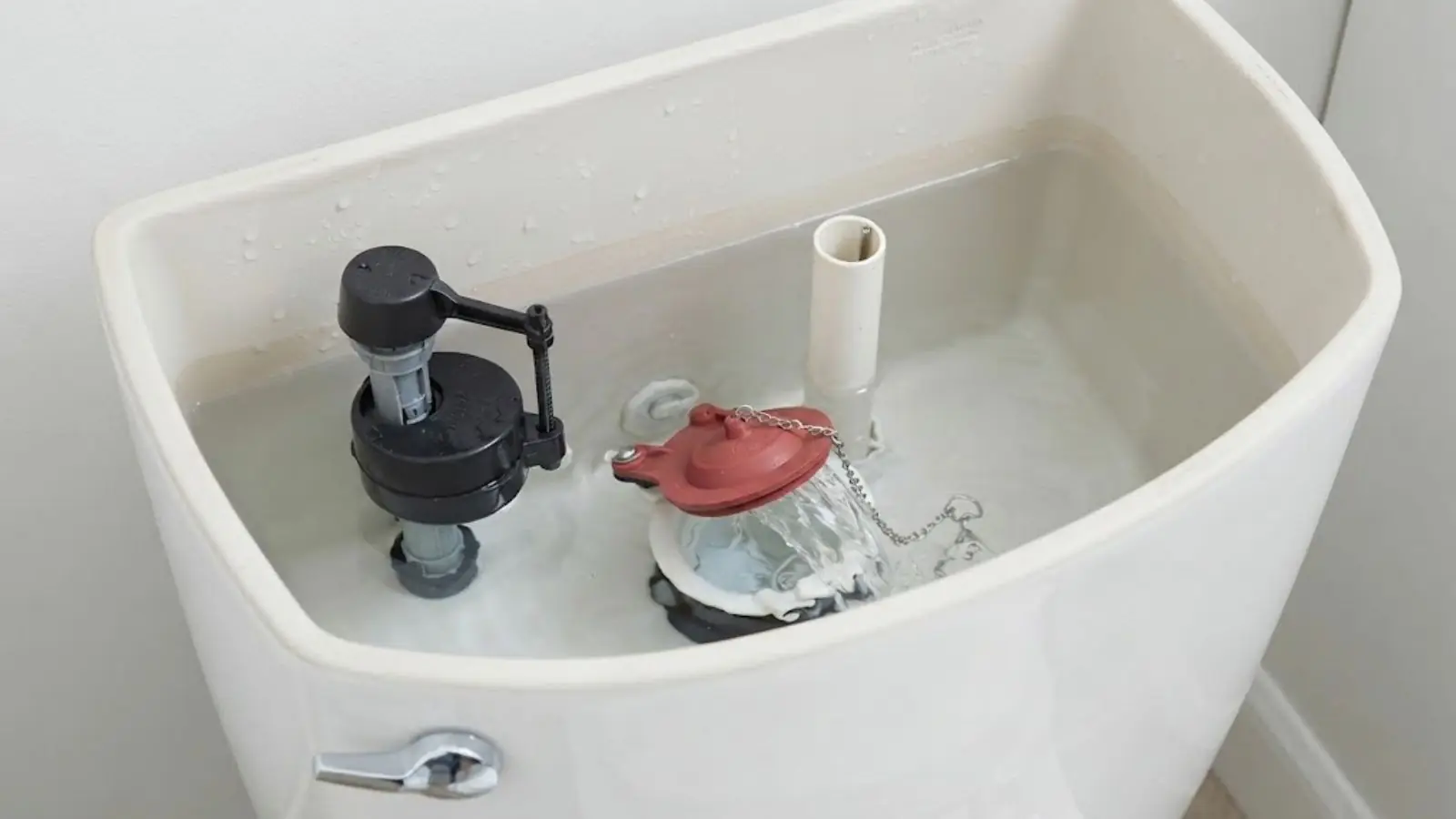
A toilet flapper is the rubber seal at the bottom of the tank that lifts to flush and drops to stop water flowing into the bowl. When it hardens, warps or collects debris, it leaks, and the tank refills over and over. A new flapper is a few minutes of work and one of the cheapest fixes in plumbing.
If your toilet is overflowing or leaking at the base, the flapper is not the problem. Close the valve behind the toilet and see our toilet repair page.
Confirm it is the flapper
Put a few drops of food coloring in the tank and wait fifteen minutes without flushing. If color shows in the bowl, the flapper or its seat is leaking. A toilet that refills on its own every few minutes, a hissing sound or a rising water bill also points here.
Hard or warped rubber
The flapper no longer seals the seat, even though it looks fine.
Chain too tight
The chain holds the flapper open slightly after a flush.
Chain too loose
The flapper does not lift fully and the flush is weak.
Mineral or slime on the seat
Debris keeps the flapper from sealing.
Wrong size flapper
A two-inch seat needs a two-inch flapper and a three-inch needs a three-inch.
Replace the flapper
Turn off the water
Close the valve behind the toilet and flush to empty the tank.
Remove the old flapper
Unhook the chain and slide the flapper ears off the pegs on the overflow tube.
Clean the seat
Wipe the rim of the opening with a cloth to remove film and debris.
Install the new flapper
Fit the ears on the pegs and hook the chain with a small slack, about half an inch.
Test
Turn on the water, let the tank fill, flush and check the seal again with dye.
Match the size. A three-inch flapper on a two-inch seat will not seal. Most toilets built in the last twenty years use a two-inch or three-inch, and the manual or a hardware counter can tell which.
When the flapper is not the problem
| Symptom | Cause | Fix |
|---|---|---|
| Dye shows in the bowl | Flapper or seat | Replace flapper, clean seat |
| Water runs over the overflow tube | Fill valve set too high or failing | Adjust or replace fill valve |
| Hissing while full | Fill valve | Replace fill valve |
| Tank refills often | Flapper or seat leak | Replace flapper |
If a new flapper does not stop the leak, the seat may be pitted or the fill valve may be stuck. See our faucet repair and toilet repair pages for related fixes.
Local note: chloramine and your water bill
Chloramine, rubber parts and the bill
Union County Water's 2023 water quality report lists chloramine as the final disinfectant, and the City of Monroe's FY2023 report describes chlorine and ammonia added to disinfect, which is also chloramine. Some rubber compounds age faster in chloraminated water, and many flapper makers now sell chloramine-resistant models.
A running toilet can waste a lot of water, and your bill reflects it. Use the dye test, and if the meter keeps moving with everything off, a toilet is the first fixture to check. Ask your utility if you are unsure where to find your meter.
Our Monroe plumber page and service areas page cover where we work.
Prevent repeat problems
Use a chloramine-resistant flapper if available, avoid in-tank drop-in cleaning tablets that attack rubber and check the toilet when the bill rises. A fresh flapper every few years is a cheap habit.
Choosing the right flapper
Flappers come in different sizes, shapes and materials. A standard rubber flapper fits many toilets, while a universal flapper has adjustable parts for odd models. Some are made from compounds that resist the chemicals in treated water. The two-inch and three-inch sizes refer to the flush valve opening, and the wrong size never seals.
If your toilet is a newer low-flow model, the manufacturer may specify a flapper with a particular timing. Using a generic part can change the flush. When in doubt, take the old flapper with you or photograph the tank, the chain and the valve.
Adjusting the chain correctly
The chain between the handle arm and the flapper should have about half an inch of slack. Too tight, and the flapper cannot close fully. Too loose, and it will not lift high enough for a full flush. Clip off any excess chain so it cannot tangle under the flapper.
A small detail like this explains many repeat problems. People replace a flapper, hook the chain too tight and wonder why the toilet still runs. Check the slack as the last step of the job.
Other parts that cause a running toilet
If the flapper is fine and the toilet still runs, look at the fill valve, the float height and the overflow tube. A fill valve that sticks open keeps the tank topping up, and water spills into the overflow. Adjusting the float or replacing the fill valve fixes it. Our toilet repair page explains the full list.
Flapper questions
How long does a toilet flapper last?
Often several years, but rubber ages faster in some water and with in-tank cleaners.
Why does my toilet run after I changed the flapper?
The chain may be too tight, the seat may be dirty or pitted or the fill valve may be failing.
Do tank cleaning tablets damage flappers?
Many tablets contain chlorine that can harden rubber. Avoid them.
Is chloramine in Indian Trail water a problem for flappers?
It can age some rubber faster. Choose a chloramine-resistant flapper.
How much water can a running toilet waste?
Enough to show on your bill. A leak you can barely hear may use hundreds of gallons a day.