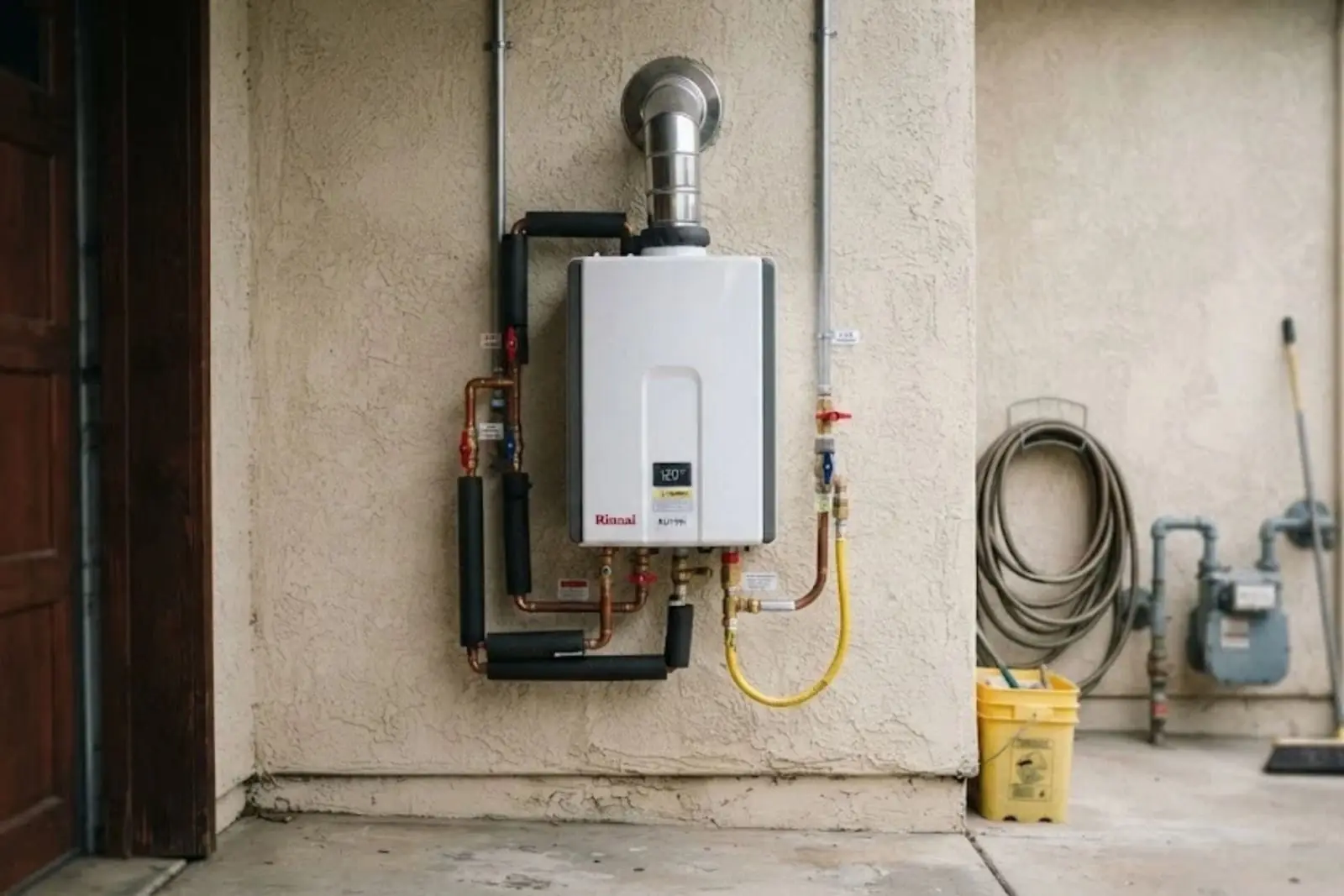
A gas tankless water heater can be installed indoors if it is a model approved for indoor use, if it vents to the outside through the correct pipe and if it receives enough combustion air and gas. Many homes do this in a garage, a utility room or a closet. The details decide whether the job is safe.
Never relight or work on a gas appliance if you smell gas. Leave the house, call the gas utility or 911 from outside, then call us. Our tankless water heater page covers tankless service in detail.
What an indoor install requires
Approved model
The unit must be rated for indoor installation and follow its manual.
Correct vent pipe
Most use sealed stainless or polypropylene. Standard metal flue is not the same thing.
Clear vent termination
The vent must exit at a safe distance from windows, doors and air intakes.
Combustion air
Non-sealed units need enough air in the space. Sealed units bring air in through a pipe.
Condensate drain
Condensing units produce acidic water that needs a drain and often a neutralizer.
Gas supply
The line and the meter must supply enough fuel when the unit fires at full rate.
Sealed and non-sealed combustion
| Type | Air source | Use |
|---|---|---|
| Sealed combustion | Air piped from outside | Tight closets and living spaces |
| Non-sealed | Air from the room | Larger spaces with adequate air |
A sealed unit draws air through its own pipe and is the safer choice for tight spaces. A non-sealed unit needs a room with enough volume or vents to the outside. The wrong choice can starve a unit of air and create carbon monoxide.
Carbon monoxide detectors near any gas appliance and on each level of the house are essential. Test them on a schedule and replace them when they expire.
Gas line and permit
Union County Building Code Enforcement says a permit is needed for the addition or change in design of plumbing, heating, air conditioning and electrical wiring.
It also says a water heater swap is exempt only if there is no change in fuel, energy source, location or capacity and no change in the routing of venting and piping. A switch from a tank to an indoor tankless unit changes the vent and often the gas piping, so plan for a permit and an inspection.
These items shape the price of an indoor gas tankless install.
A permit and inspection protect you if you sell the home. Unpermitted gas work can cause problems at closing.
Local note: who to call and what to check
Licensing and permits in Union County
North Carolina plumbing and gas work is licensed through the State Board of Examiners of Plumbing, Heating and Fire Sprinkler Contractors, which maintains a public license search at nclicensing.org and can be reached at 919-875-3612. Verify any contractor before they open a gas line.
Union County Building Code Enforcement handles permits. Ask the county whether your project needs one, since a change in fuel, venting or piping routes falls outside the permit exemption for like-for-like water heater replacement.
For a home near the county seat, see our Monroe plumber page, and the service areas page for other towns.
Is indoor the right choice
If you have a garage wall with a short vent run, an indoor install is often the simplest. If the vent path is long or the space is tight, an outdoor model or a different location may fit better. An honest plumber measures first and quotes the real work.
Clearances and where not to put it
The manual for any indoor unit lists clearances to walls, ceilings and combustibles, and the unit must have access for service. Avoid spots that are cramped, damp or full of stored items such as paint and solvents, because vapors and dust can foul a burner. Garages call for the burner to be protected from impact, and some codes call for elevation.
| Location | Common issue | What to check |
|---|---|---|
| Garage | Impact and fumes | Protection from vehicles, clean air at the burner |
| Closet | Tight space | Sealed combustion, clearances and service access |
| Basement | Moisture | Drain for condensate, dry surfaces |
| Laundry room | Lint | Keep the area clean and the vent clear |
Carbon monoxide safety
Carbon monoxide is odorless and dangerous. Any gas appliance that vents poorly can release it indoors, which is why venting and combustion air are not details to cut corners on. Install a carbon monoxide detector on every level and near sleeping areas, test it monthly and replace it by the date on the label.
If an alarm sounds, get everyone outside, call 911 and do not go back in until emergency responders say it is safe. Do not try to find the source yourself. After the scene is safe, call a licensed plumber or gas technician to inspect the appliance before it runs again.
After the install
Ask for the manual, the permit paperwork and the date of the first flush. A well-run install leaves you with service valves, a clear label showing the gas supply rating and instructions for the error codes. Keep the paperwork where you can find it, since it matters at resale. Our tankless service page explains the annual flush, which keeps the heat exchanger healthy and the warranty intact.
What to do if you smell gas or an alarm sounds
- Leave the house at once and do not flip switches
- Call the gas utility or 911 from outside
- If a carbon monoxide alarm sounds, get everyone outside and call 911
- Do not go back in until responders say it is safe
- Have a licensed technician inspect the appliance before it runs again
Indoor tankless questions
Can a gas tankless water heater be installed inside the house?
Yes, if it is rated for indoor use, vented correctly and supplied with enough gas and combustion air.
Do I need a carbon monoxide detector?
Yes. Any gas appliance calls for working detectors near sleeping areas and on each level.
Does Union County require a permit?
A change from a tank to tankless typically changes venting and piping and needs a permit. Confirm with the county.
Why does my gas bill matter?
Tankless units fire at a high rate, so the line and meter must support it.
Can I vent through the existing chimney?
Usually not without a liner and an approved vent. A plumber can check.