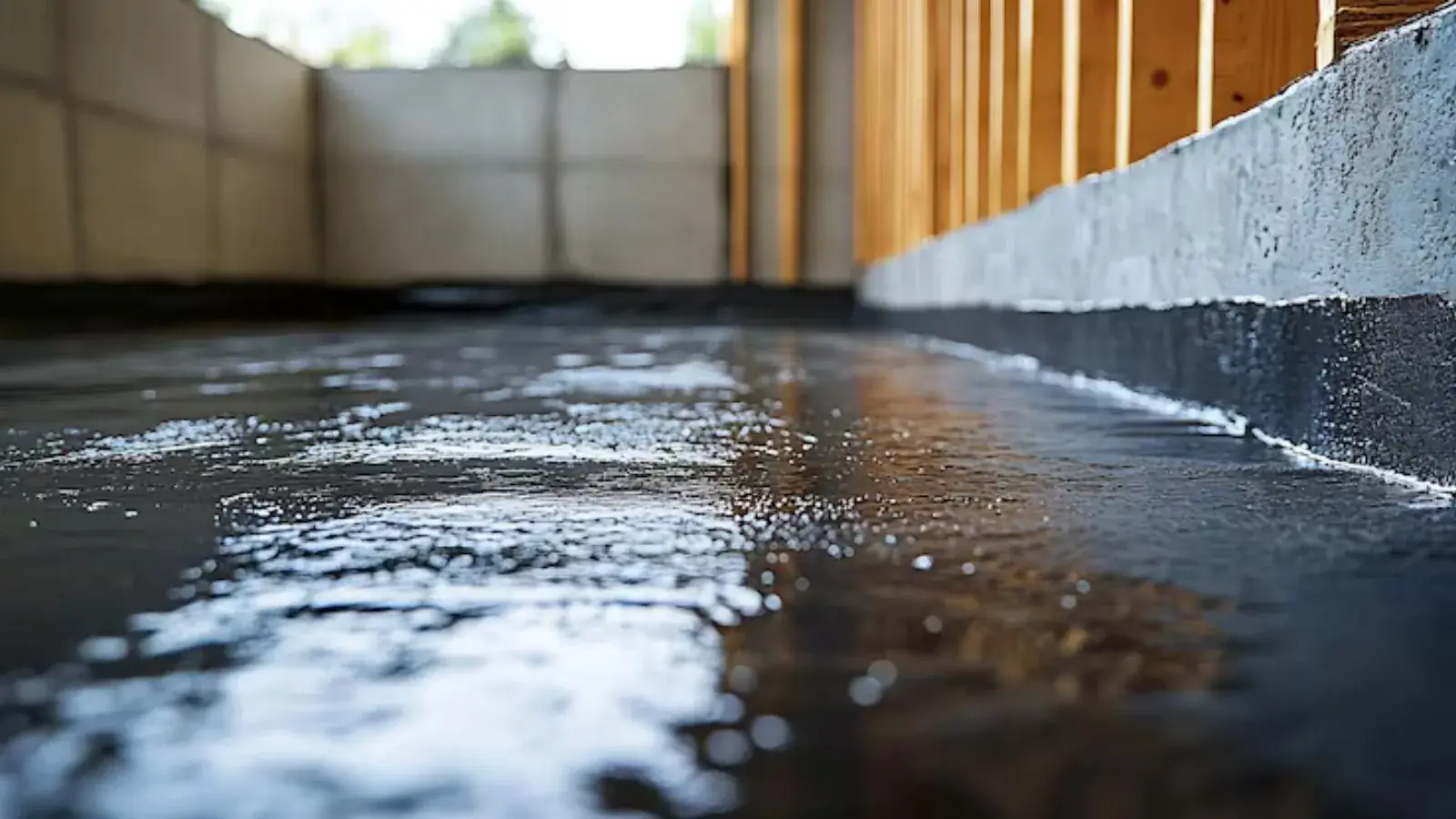
Liquid rubber is a coating, usually a polymer or asphalt-based product, that you brush or spray onto concrete or block to form a continuous waterproof layer. It can slow dampness and seal small seepage on a wall. It does not stop water pressing through a floor or wall from saturated soil, and a coating that peels under pressure can trap water behind it.
If water is rising in the basement now, stop reading and call. Our sump pump repair page and the 24/7 line are the quick path.
Where a coating helps
Damp walls
A coating reduces vapor and light seepage through concrete or block.
Hairline cracks
Some products bridge small cracks and stop minor weeping.
Clean dry surface
Coatings stick best to clean, sound masonry.
After drainage is fixed
A coating adds a second layer once water pressure is handled.
Where it fails
| Situation | Result |
|---|---|
| Active water under pressure | Coating peels or blisters |
| Wet or efflorescent wall | Poor bond |
| Large moving cracks | Coating tears |
| Floor seepage from below | Cannot stop hydrostatic pressure |
The cause of the water decides the fix. If gutters dump water at the wall, fix the gutters. If grading slopes toward the house, regrade. If groundwater pushes through the floor, interior drainage and a sump pump are the usual answer, and a coating is only a finish.
Do it in this order
Find the source
Check gutters, downspouts, grading and plumbing leaks before anything else.
Fix the outside
Extend downspouts, clean gutters and slope soil away from the wall.
Add drainage if needed
An interior drain and a sump pit move water that still gets in.
Coat last
Clean the wall, repair cracks and apply the coating by the label.
Local note: Piedmont clay and a wet season
Soil and rain in Union County
Union County sits in the North Carolina Piedmont, where clay soils hold water and drain slowly. After heavy rain the ground around a foundation can stay wet for days, and that builds pressure against walls and floors. A coating applied inside does little against that pressure.
Many Indian Trail homes are slab or crawlspace builds, so a full basement is not universal, but crawlspaces take on water too. If you plan changes to grading or a sump discharge, ask Union County Building Code Enforcement and your utility about local rules.
Our Monroe plumber page and service areas page describe where we work.
How to decide
If the wall is merely damp and the cause is condensation or light seepage, a coating plus a dehumidifier may do it. If puddles form after rain, plan for drainage. A plumber can look at the pattern and tell you which path fits your house.
Preparing a wall for a coating
Preparation decides whether a coating lasts. The wall must be clean, sound and dry. Remove loose paint, efflorescence, which is the white powdery salt that appears on masonry, and any flaking material. Repair cracks and holes with a patching compound suited to masonry, and let the patch cure as directed. Use a wire brush and a vacuum, then wipe the surface.
Apply the coating when the weather and the wall are dry and the temperature is within the label range. Thin coats applied evenly work better than one thick coat, and each coat needs to cure before the next. Skipping cure time is a common reason coatings blister.
Signs a coating will not be enough
Puddles on the floor after rain
Water is entering from below or at the footing, and a wall coating will not stop it.
Wet walls with white mineral crust
Moisture is moving through the masonry and pushing salts to the surface.
Cracks that open and close
Movement will tear a rigid coating.
A sump pit that fills fast
The site has a groundwater problem that needs drainage.
Water at the floor-wall joint
The cove joint is the classic entry point and needs interior drainage.
What a plumber looks at first
A plumber starts by ruling out plumbing. A slow leak in a supply line or a drain can mimic seepage, and the fix is a repair, not a coating. After that, the plumber looks at the pit, the pump and the discharge, because many wet basements have a pump that is undersized, failing or draining too close to the house.
Where water enters through the floor, an interior perimeter drain that leads to a sump pit is a proven approach. It collects water at the footing and pumps it away. A coating can still be applied afterward to finish the wall. Our basement waterproofing page explains how the pieces fit together.
Cost thinking
Coatings are cheap compared with drainage systems, which is why they tempt people. The risk is paying for a coating and still having water. A modest investment in finding the source first saves the cost of doing the job twice. Ask for a plan that handles the cause, and treat any quote that starts with the coating as a prompt to ask why.
Sources behind this guide
Coating products carry manufacturer guidelines for surface preparation, temperature and cure time, and those guidelines override anything general we say. Drain and sump work follows the State Plumbing Code, which adopts the International Plumbing Code (IPC).
Liquid rubber questions
Does liquid rubber stop a basement leak?
It can stop light seepage on a sound wall. It will not stop water under pressure.
Can I apply it to a wet wall?
No. The wall must be clean and dry for the coating to bond.
Is condensation the same as a leak?
No. Tape foil to the wall for a day. Moisture on the outside of the foil means condensation.
Do I still need a sump pump?
If water enters the floor or footing, yes. A coating does not replace drainage.
Are Indian Trail basements prone to water?
Piedmont clay holds water, so lower levels and crawlspaces can get wet after heavy rain.