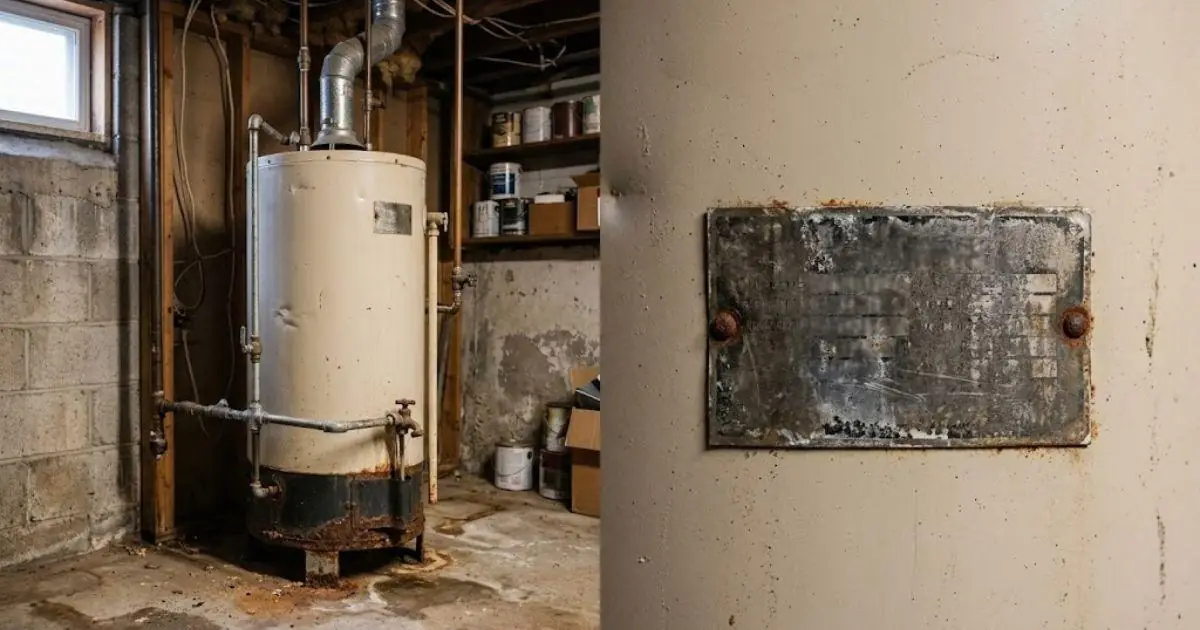
A standard tank water heater is commonly rated for roughly eight to twelve years, and many fail inside that window. A tank that is past ten years old and showing rust, leaks or noise is a candidate for replacement. A tank under eight years old with no leaks usually deserves repair.
If water is leaking from the tank right now, it is already time. Shut off the water and power and see our water heater replacement page.
How to find your tank's age
The data plate on the side of the tank has a serial number, and many makers encode the manufacture date in it. The first letter or two digits often mark the month and the year. Because codes vary by brand, search the maker's site or photograph the label for a plumber to decode.
If the plate is gone, other clues help. The age of the house, the date of the last remodel and the style of the tank all hint at how old it is. A tank that looks original in a house built in the early 2000s is probably well past its prime.
Signs it is time to replace
Age past ten years
The tank has used most of its design life.
Water at the base
A leaking tank cannot be repaired.
Rust-colored hot water
The liner or the rod may be failing.
Rumbling and popping
Heavy sediment is baking onto the bottom.
Frequent repairs
Parts keep failing and each visit costs more.
Not enough hot water
Elements or the tank are failing and recovery is slow.
What affects lifespan
| Factor | Effect |
|---|---|
| Anode rod condition | A worn rod lets the tank rust from inside |
| Sediment buildup | Hot spots and noise stress the tank |
| Water temperature | Higher settings speed wear |
| Water quality | Hardness and chemistry change scale and corrosion |
| Installation | A poor pan, vent or valve shortens life |
Flushing the tank and checking the anode rod can extend life. A tank neglected for years has less to gain. See our water heater repair page for which faults are worth fixing.
Local note: Union County water and housing age
What local conditions mean for tank life
Union County Water's 2023 water quality report listed average hardness of 23 ppm and an average pH of 7.11, with chloramine as the disinfectant. Very soft water means less scale in the tank and on elements, which can help tanks last, though the rod still wears.
Indian Trail grew from 1,942 residents in 1990 to 39,997 in the 2020 census, so many homes were built in booms between the early 1990s and the 2010s. A tank installed when a neighborhood opened in the early 2000s is now near or past the end of its typical life. That is the best local reason to check labels.
On permits, Union County Building Code Enforcement says replacement is exempt only when there is no change in fuel, energy source, location or capacity and no change to venting and piping routing. Our Monroe plumber page and service areas page describe where we work.
Planning a replacement before it fails
Replacing a tank on your schedule is calmer and cheaper than an emergency swap. You can choose the size and the type, compare gas and electric options and think about a tankless upgrade. A failed tank at night limits your choices to what is in stock.
If your tank is ten years old and you want to plan, a plumber can inspect it and give you an honest estimate of its remaining life.
What a planned replacement gives you
When you replace a tank on your own schedule, you choose the size and the fuel and can add the extras that code and comfort call for. A drain pan, a new expansion tank where one is needed and fresh shutoff valves are all easier to add when you are not rushing. You can also compare a standard tank, a heat pump model and a tankless unit without the pressure of a cold shower.
An emergency replacement is still a good replacement, but the choices narrow to what is in stock and what can be installed today. The extra planning is the difference between a decision and a reaction.
Warning signs that deserve a call
Moisture around the base
Check the pan and the floor. Even a damp ring can mean a slow seam leak.
A tank that has never been flushed
Sediment builds quietly and shows up as noise and slow recovery.
Hot water that runs out sooner than it used to
The lower element or the tank is failing.
Corrosion on the fittings
Rust at the inlet and outlet shows moisture and age.
A relief valve that drips
It can mean excess pressure or a failing valve, and either needs attention.
Extending the life of the tank you have
Flushing the tank once a year removes sediment. Checking the anode rod every few years protects the steel. Setting the temperature at a reasonable level, rather than the highest setting, reduces wear. Keeping the area around the tank clear gives you a chance to spot leaks early.
None of this stops a tank from aging, but it can add useful years. Our water heater repair page explains which faults are worth fixing at each age.
Water heater age questions
How many years does a water heater last?
Many tank units last roughly eight to twelve years. Conditions and maintenance change that.
How do I read the serial number?
Brands encode the date differently. Look up the maker's code or send a photo of the label to a plumber.
Should I replace a ten-year-old tank before it fails?
If it shows rust, leaks, noise or poor performance, yes. If it is clean and quiet, you can monitor it.
Do homes in Indian Trail built in the 2000s have old tanks now?
Many do. A tank from a subdivision opened in the early 2000s is likely past ten years if it was never replaced.
Does a flush extend tank life?
A flush removes sediment and can help, especially when combined with a rod check.